
SEO for industrial suppliers
Help buyers choose the right plastics supplier
Industrial buyers search for a process, material, tolerance, application, or proof point. SEO should make your capability easier to evaluate and give the right buyer a clear route to a useful RFQ.

Help the buyer rule a supplier in or out
A procurement team needs to know whether a supplier is worth approaching. Engineering needs to check the part requirements. Operations needs to understand production and delivery. A page headed only “plastic manufacturing” leaves all three with unanswered questions.
Start with one process and the work you want to quote. Explain the capability, its limits, and the information needed for a request for quotation (RFQ).
- Which processes, materials, and part types do you handle?
- What production quantities and project stages fit your work?
- Which requirements need a drawing or technical review?
- What evidence can the buyer examine before sending an enquiry?
Give each technical page a different job
Process pages
For injection molding, extrusion, CNC plastic machining, thermoforming, or assembly, describe the work your facility actually performs. Explain relevant part types, quantity ranges, finishing, assembly options, and prototype or sample routes. Distinguish in-house work from subcontracted operations.
Material pages
For materials such as ABS, PP, PE, nylon, acrylic, or PEEK, identify the grades you can work with and link to the applicable supplier data. Explain which temperature, chemical exposure, appearance, or other requirements the buyer should provide. A polymer family name alone is not approval for a particular application.
Application pages
Show how your work relates to an industry or operating environment. An approved example should describe the part’s function, manufacturing requirement, approach, and evidence available. Remove identifying customer details when you lack permission to publish them.
Facility pages
State where the work is carried out, the relevant equipment and services, and how to contact the right team. Explain the factors that affect lead time, such as drawing approval, tooling, material availability, sampling, and order quantity, without promising a schedule before review.
Turn “please quote this cover” into a useful brief
Consider a hypothetical buyer requesting a molded cover for an industrial enclosure. A photograph and a quantity may start a conversation, but the supplier will need more detail to assess and quote the work.
- Part definition: Send the current drawing and available model, with revision and units. Identify dimensions and features that matter to fit.
- Material: State the specified grade, or explain that selection is still open. Describe the operating conditions and requirements that need assessment.
- Quantity: Separate prototype or sample needs, the first order, and expected repeat quantities. Label forecasts as estimates.
- Appearance and assembly: Describe the required color, finish, marking, inserts, and mating parts where relevant.
- Quality evidence: Name required inspection records, traceability, tests, or approval steps rather than asking for “high quality.”
- Timing and destination: Give the desired sample and production dates, delivery location, and a contact who can answer technical questions.
This is an enquiry example, not a part design or a declaration that any process or material is suitable. If a requirement is undecided, say so. Let the supplier identify what must be resolved before a firm quotation.
Show the part, not only the keyword
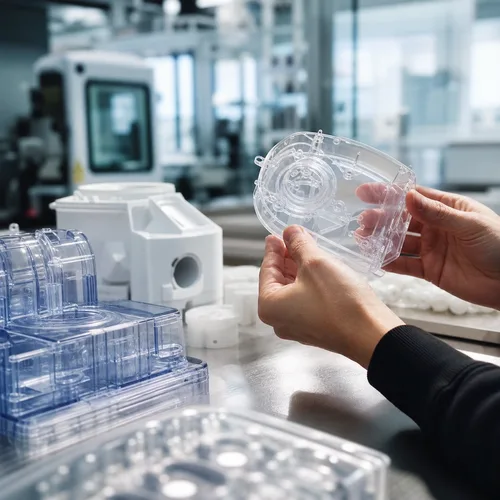
A buyer can understand a process faster when the page connects words to a real part, material and inspection context. Use a clear image beside the explanation, then state what the reader should notice: the part’s function, the finish, the features that affect fit, and the checks that support the claim.
Keep the essential specification in text as well. The image invites the question; the written capability, limits and evidence help the buyer decide whether to send an RFQ.
Put evidence beside the capability
A buyer comparing two suppliers should be able to check what a claim covers. Link relevant certificates, inspection information, and approved examples from the capability page instead of leaving them in an unrelated download list.
Keep the statement precise. A published capability range should explain its conditions; a demanding part still needs review against its drawing and requirements.
- Certification: Show the applicable standard, certified organization and site, scope, issuing body, and current certificate details. ISO explains how certification can be verified and that ISO itself does not issue certificates.
- Inspection: Explain what is measured, when it is checked, and which records can accompany the work. Distinguish routine checks from additional customer requirements.
- Examples: Explain the specific requirement and your contribution. Do not imply that a quality-system certificate proves every product meets every customer requirement.
Make the RFQ route work for incomplete enquiries
Tell buyers which drawing and model formats the team can accept, how to send files, and how to arrange confidential sharing when needed. Keep an engineering-enquiry option for buyers whose material, drawing, or volume is not yet settled.
After submission, explain whether the next step is technical clarification, a feasibility review, or a quotation. State only response times the team can support. A message acknowledging receipt should not imply that the part has been accepted for manufacture.
Use the enclosure-cover example to test the form with non-confidential sample files. Check that the files arrive intact, the revision is clear, and the request reaches the intended team. Also test a request with no finished drawing and verify that the buyer can still ask for the appropriate help.
Check discovery as well as the quote form
Use descriptive page titles and headings that identify the actual process, material, or application. Link related capability and material pages so a buyer can move from a general requirement to the relevant evidence and contact route.
Check that public pages load on a phone, text and documents are readable, and links to specifications, certificates, and enquiry forms work. Keep essential capability information in readable page content rather than only in an image.
Google’s SEO Starter Guide explains discovery and page-access checks. These checks help search engines understand the site; they do not guarantee indexing, rankings, or orders. Avoid creating near-identical pages for every material-and-location combination without useful information for that buyer.
Let enquiry quality choose the next improvement
The wrong work
Group unsuitable requests by the mismatch: process, material, quantity, application, or delivery requirement. If one capability page repeatedly brings the wrong work, make its scope clearer before seeking more visits.
Missing information
Record which details the team repeatedly has to request, such as a drawing revision, material grade, or sample quantity. Add an explanation beside the RFQ form and check whether later requests are more complete.
Relevant demand
Review qualified organic RFQs, calls and form actions from capability pages, and the process or material searches that brought visitors. Separate a complete enquiry from a quotation, an accepted order, and unrelated educational traffic.
The first page to revise
Take one recent enquiry that required avoidable clarification. Add the missing answer to the relevant capability, material, or application page, then test the RFQ route again with a sample request.
Turn a useful page into a useful RFQ
Share your plastics manufacturing website, the process or material you want buyers to understand, and the questions that slow down your enquiries. We can help you make the next capability page easier to evaluate.