
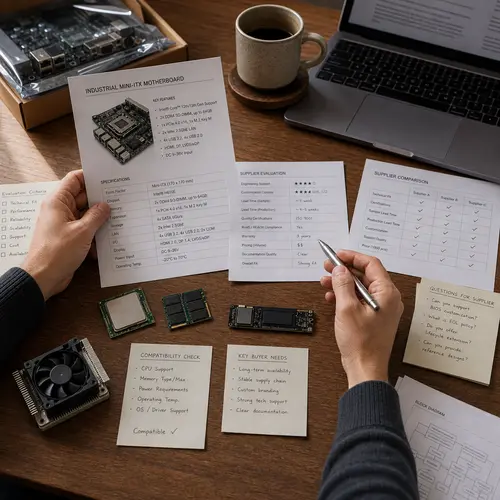
Hardware buyers search by fit, reliability, and lifecycle.
A buyer may search by chassis, industrial PC, embedded system, peripheral, rugged device, component compatibility, certification, lifecycle support, volume, or supplier location.
SEO for computer hardware manufacturers should make fit easy to evaluate before the first enquiry. The page has to answer the questions engineering, procurement, IT, quality, and operations teams already have.
The practical promise
Hardware buyer intent is specific
The useful traffic is not always the biggest keyword. It is the search that reveals a buyer has a real product, compatibility, certification, lifecycle, or reliability problem to solve.
Capability intent
Industrial PC, embedded system, peripheral, enclosure, component, and custom-build pages help buyers match your capability to their need.
Certification intent
Compatibility, certification, warranty, documentation, testing, and lifecycle pages make supplier fit easier to judge.
Application intent
Industry and application pages show that you understand where the hardware must operate, not only what the product is called.
The site should clarify fit before the enquiry.
A good computer hardware page does not try to attract everyone. It helps the right buyer understand fit, constraints, evidence, and the information your team needs before quoting.
That saves time for sales, engineering, and support teams. More importantly, it makes the buyer feel that your company understands the environment before they ask for a configuration or quote.
Give buyers the essentials
Build pages around how hardware buyers compare suppliers
The strongest content often sits close to the buying decision: product-family pages, capability pages, quality pages, application pages, and the RFQ path.
Product pages
Quality pages
Application pages
Proof surfaces
RFQ paths
Technical SEO
Measure quality of demand, not only traffic.
A computer hardware manufacturer can get irrelevant visits from broad educational searches. The better question is whether the site brings the right buyer to the right capability page and helps them send a usable enquiry.
Reporting should connect rankings and traffic to RFQs, contact paths, capability-page engagement, and the content gaps that still cause weak enquiries.
Useful metrics
Frequently asked questions
Why does SEO matter for computer hardware manufacturers?
Procurement, engineering, IT, and operations teams often research suppliers before they contact anyone. SEO helps your product families, build capabilities, certifications, quality systems, and RFQ path appear when buyers compare options.
Which pages should a computer hardware manufacturer improve first?
Start with product-family pages, capability pages, quality and certification pages, application pages, facility or location pages, and clear quote or engineering enquiry paths.
Should computer hardware SEO target broad keywords?
Broad keywords can help, but specific buyer intent is usually more valuable: component type, product family, ruggedness, compatibility, certification, lifecycle, volume, and industry requirement.
What content helps computer hardware buyers trust a supplier?
Useful content explains product options, compatibility, lifecycle support, testing, certifications, customization limits, lead-time factors, and what information the buyer should send for a useful quote.
What should computer hardware manufacturers measure from SEO?
Measure qualified RFQs, quote-form completion, calls from buyer-intent pages, engagement with product and capability pages, and whether enquiries include the detail needed for sales or engineering to respond.
Good hardware SEO makes the right supplier easier to choose.
The strongest pages help engineering, procurement, IT, and operations teams understand whether your hardware matches their requirement before they ask for a quote. That is a better use of search than chasing broad traffic that never becomes a useful conversation.
Start with the pages that clarify product fit, quality, application, proof, and next step. Those are the pages that can turn discovery into a serious RFQ.